




















CBSE allows mixed subjects in Class 11, but core streams continue to drive choices

CBSE allows mixed subjects in Class 11, but core streams continue to drive choices
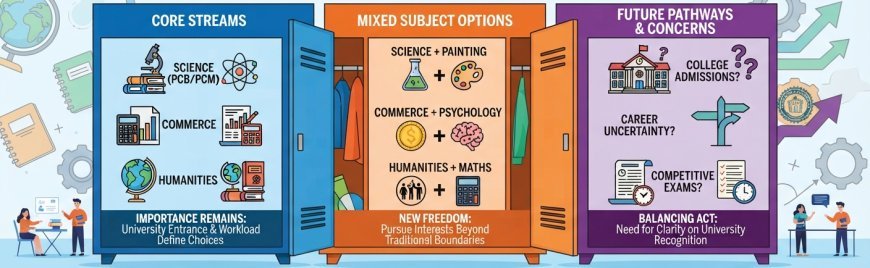
Class 11 students are combining subjects beyond the traditional Science, Commerce and Humanities streams for the first time this CBSE academic session, but the new flexibility has not diminished the importance of the core streams. Students are using the option to continue interests outside their main subjects, while career pathways and competitive entrance requirements continue to influence choices.
The reform allows students to select subjects across disciplines, but the workload of core subjects remains the deciding factor for most learners.
Anika Sharma, a Class 11 student, has opted for Painting along with PCB (Physics, Chemistry, and Biology), allowing her to pursue her creative interests while pursuing science.
“I wanted to continue with science, but I did not want to leave painting behind,” Anika said. “Earlier, choosing a stream often meant leaving other interests. Having this option gives students more freedom.”
However, Painting remains an additional subject, while PCB continues to be her primary academic focus.
“If I was entering Class 11 today, I would probably choose something beyond the traditional streams,” said Lakshya K, a Class 12 student. “But it is not easy. The best I could hope for is getting one interesting subject instead of taking only Commerce subjects.”
Lakshya said students still have to consider future academic pathways. “I might want to choose a subject because I love it, even if I am unsure about its impact on college admissions, but it is scary. I would probably not take that risk,” he said.
CBSE coordinator UK Jha said implementing individual choices requires detailed planning. “Student flexibility is the objective, but implementation requires coordination of teachers, classrooms and timetables according to the combinations students select,” he said.
Principal Winston Gomez said schools must balance flexibility with academic structure. “Students should get opportunities, but they also need a strong base in their main subjects. The system has to support choices without affecting learning,” he said.
The reform has also changed classroom preparation with greater focus on competency-based questions.
“Students cannot depend only on remembering formulas or standard answers. They need to understand concepts and apply them,” said PGT Mathematics teacher Pankaj Mishra.
TGT English teacher Kuldeep Kaur said the focus is shifting towards interpretation and reasoning, while TGT Social Science teacher Arva Shakir said interdisciplinary learning can help students connect subjects better.
Parent Hitesh Jhariya supports the flexibility but wants clarity about future pathways.
“I personally want my child to have all the freedom,” Jhariya said. “The concern is that they could be completely lost in college if universities and entrance systems do not recognise these combinations.”